Thursday, March 13, 2014

Quadmaran model build


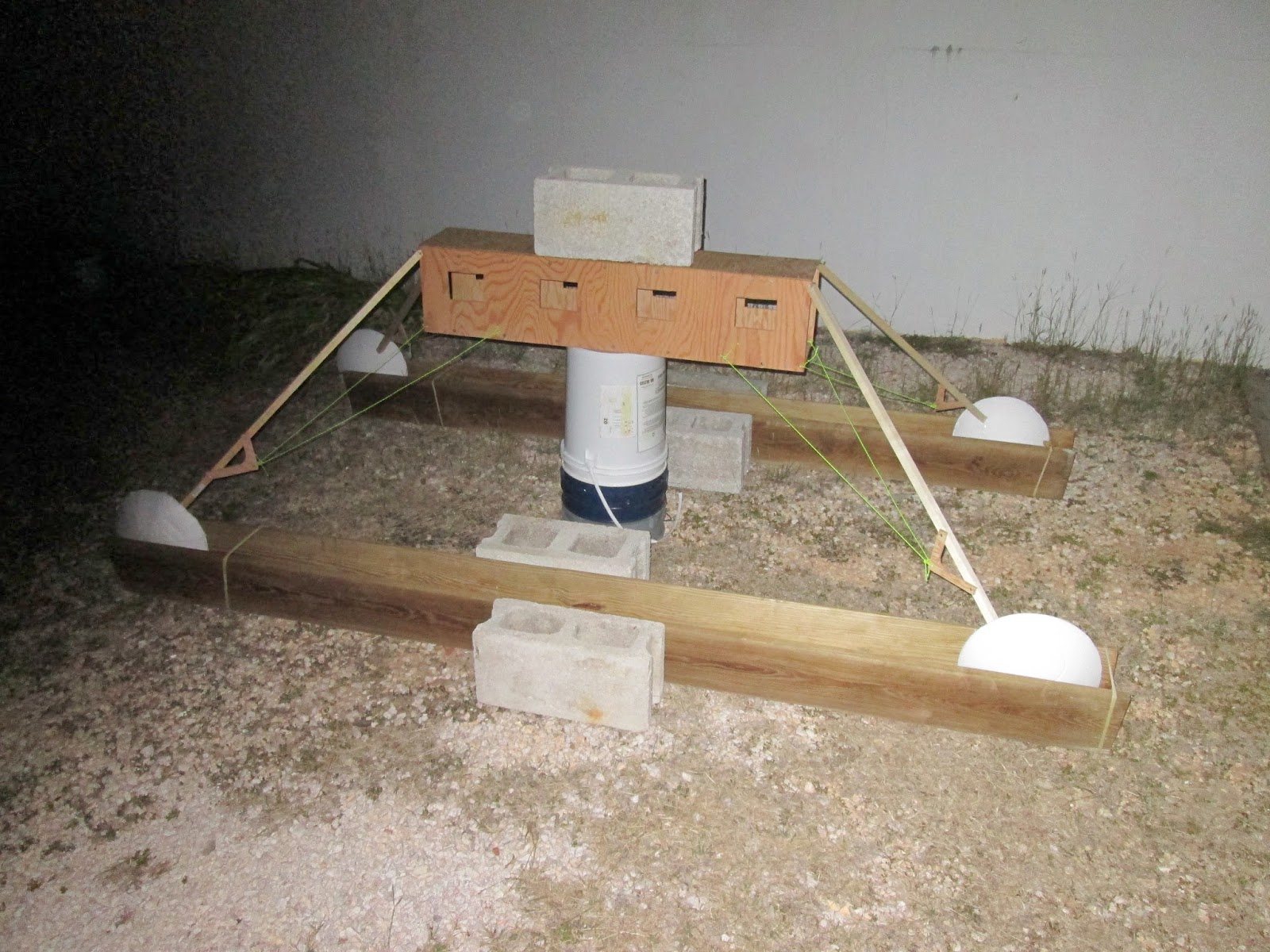
My quadmaran idea is that with 4 legs on a 40 foot container and 4 floats we could have a stable platform.  With just the right shape and size floats they and the legs could fit inside the container.  So the whole thing could be shipped as one container and then put together.   With the right shape floats they can have a soft motion in the waves.  With the wide stance, like 40 feet wide and 70 feet long, it would not tip too much or too fast.   Could be very comfortable even when moving at slow solar power type speeds.

Found a 16 inch styrofoam ball on Amazon.


We put the ball in a trash bag on top of some cement in a short bucket to make a mold.
 We were not that happy with the mold.
 Putting the ball on a bucket and using a hot wire we cut off 6 sections, leaving a cube.
 What is left is kind of like a big die.

Showing how 4 floats could be fit inside.  This box is 40 inches long, so we are modeling at 1:12 scale.


And 8 by 9 foot container (higher type) has about 11 foot diagonal.
 We had 6 nice halfs of floats, which makes 3 floats, but we needed another.  Also wanted to test out way to make the right shape for larger models.  Maybe half scale or full scale.  So edges of hotwire are tied to point on the side of the bucket and we can make 8 inch radius curves like on the 16 inch diameter ball.   By rotating the styrofoam and cutting many times we can make a reasonable approximation to the section of a sphere.
 Something sticking up in the middle so we can rotate foam about it.
 Discarded foam from first cuts.


Cut ends of legs so they fit over sides of box.  Then drilled holes through legs and box.  Then quicktie to hold together.

Box and legs with foam floats in general area to get idea of where we are headed.
 I used sun hardening resin for the fiberglass.  So I set things up the night before and got up a half hour before the sun.  Note how nice and smooth the floats were before the resin.

 The resin has eaten out big pieces of the foam.
 We tried to patch up foam with spray foam.  And painted things.
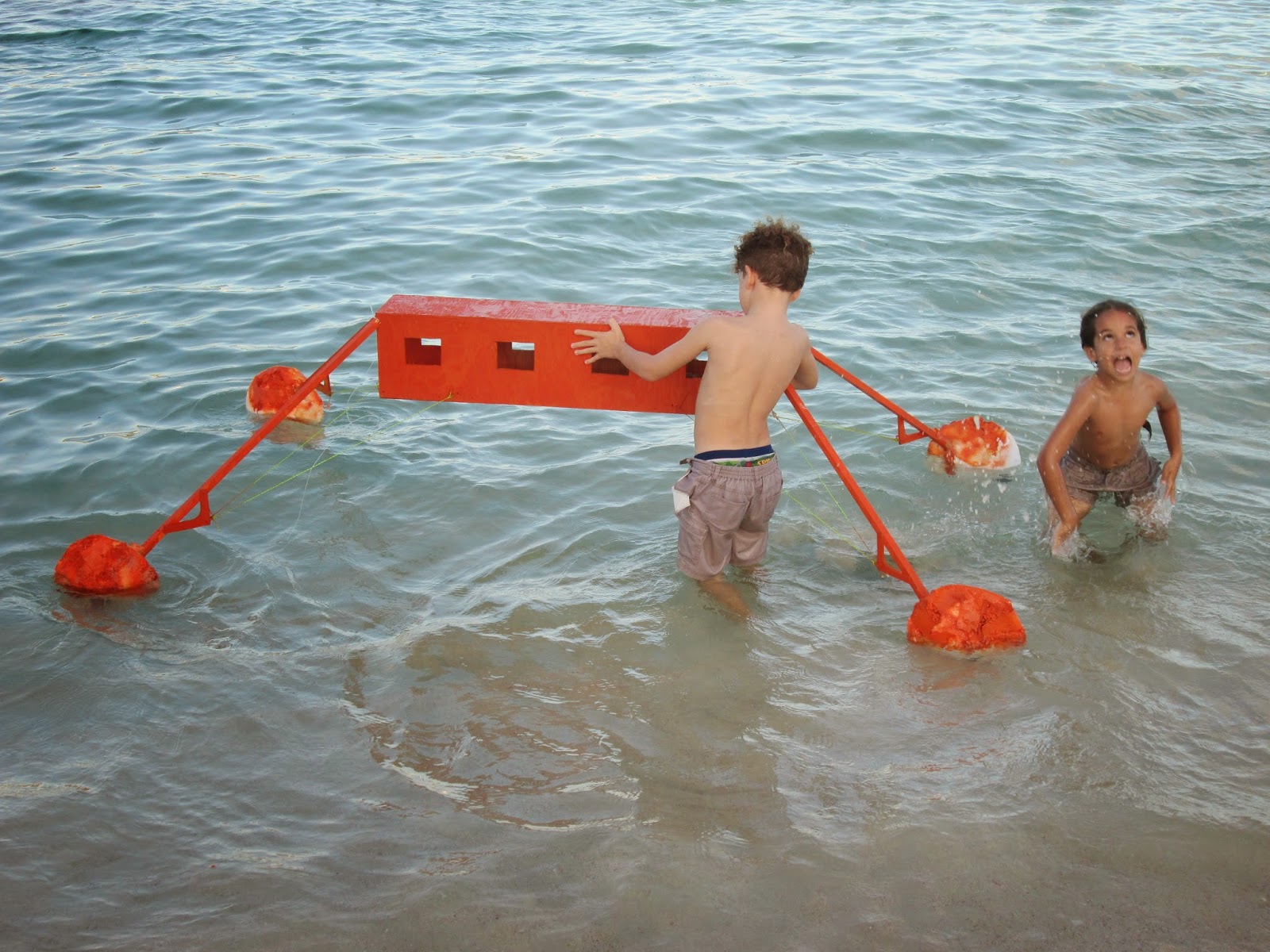
 It floats!  Put in sand to weigh it down so floats were about halfway in the water.


It starts out high in the water so I have my 4 year old put sand inside to weigh it down.


Took a bunch of sand but then it is down in the water more.


You can get an idea how much sand in this video.


You could push sideways on a float and the strings did not go slack, the model just moved sideways.

If you slow a video down by the square root of the scaling factor it shows you what waves would act like in the full scale version.   So these videos are slowed down.

Tuesday, October 22, 2013

Hook Paravane 2

I made another hook paravane where the aluminum extends forward under the foam.   This lets me attach the string forward more.


Some videos.   The Sun was going down at my wave tank.


Thursday, October 17, 2013

Hook Paravane


I read about a hook paravane some time back but did not fully understand it.   I decided I understood enough to make one that would work so today I made one and tested it.  At first the curve was not tight enough and it could not go fast.  After bending it a bit more it worked well.  It is mostly off to the side, like a good paravane (water kite) but a bit behind.  Because it is a bit behind the lower part acts like a plow pulling the paravane down into the water.  The upper part is positioned to lift if the paravane goes too far down into the water.  So the two balance each other and it does not go down too far or pop out of the water.  This is a very light device.  This makes pulling it out of the water and onto the dock or boat much easier.  It will also take much less space on the boat.  The maximum pull is less, so I am hopefull that it will not break the line when the mast pulls hard.


This was the shape after some more bending and it worked well.
I had to start out slow.
 This last video is with the most curve in the aluminum.  It seems to work the best.  I don't think this will ever jump all the way out of the water, so it will always keep tension on the mast.  This is much better than my pipe prototypes.

Future Plans

This design has great potential.  It is also really easy to make.  I now expect the final paravane design to evolve from this basic design.  In the past I have gone from toy sailboat, aluminum foiling catamaran, to pipe, to this hook.  These are big changes in design.  From now on I expect small changes to the basic hook design.  This is a very efficient design.  Lifting my big pipe paravanes back onto a tipping boat was a bit much.  This will make for a much more practical device.  Also, because it is so light there is far less chance that it would damage the boat in any way when you are pulling it out of the water.   I think the chances of making a product that other people would like went up today.  :-)

I made this design very fast today and did not take the time to make the aluminum resemble an air-foil at all.   Doing this will reduce the drag, so it is well worth doing now that I like the basic design.

I would like to have been able to try attaching the string forward of where it was, but there was no more aluminum under the foam going forward.  In a future design I will extend the aluminum forward another 4 inches under the foam.

I seems like other hook paravanes don't have a surface following thing like my foam.  I was hoping my foam would be out of the water more and only for slow speeds but it was always part of the function.   If the foam were not touching the water there should be less drag.  So if a hook paravane can operate that way it would be better.   

Monday, August 5, 2013

Lowering Mast with Solar Panels


As I was lowering the mast it became clear the spreaders wanted to pass through the solar panels.   This was a problem.


I detached the spreader (one bolt) and lowered some more.  Then the mast was about to hit the solar panels.  So I moved all the solar panels back as far as I could without hitting the mast support.  Then I was able to lower the mast onto the mast support without the mast hitting the panels.  In this picture it looks like I have a good inch to spare, but the mast jack is still lifting on the mast.  After it is removed there was only about a half inch.   That is cutting it close.


Then moved the mast forward onto its stand and reattached the spreader.    This means I will always have to undo the bolt for the spreader, but this is not too bad.   It could have been worse.


Sunday, August 4, 2013

Solar Panels on Boat

One of the drawbacks of living in paradise is that shipping big things here can take a month or more.  So getting the right aluminum takes a long time.  Then when the welder needs more Argon gas, that takes a long time.   So living in paraside requires a certain amount of patience.  But I think it is worth it.  We now have the solar panels mounted on the boat.  Next we have to wire up the panels and the batteries.


Wednesday, July 17, 2013

First Sea Trial With 2 Paravanes


There are 2 paravanes with 2 yellow balls. Inside each ball is a fishing reel that can let the line out for the paravane automatically. This lets me toss in both paravanes at nearly the same time.


This video is the whole experiment. The left side reel let the line out at a slow speed. The right side must have had a higher drag setting on the reel as we had to move a bit faster to get it out. Eventually the fishing line knot on one of the reels came undone. I need to get better at fishing line knots. But the system for letting the lines out is getting reasonable.

One of the paravanes has been filed so that it stays down in the water better. I thought I had done the other but had not. Both of them came out of the water, so they're not the ultimate design.


Here is the view from Ethan's camera:

After a line comes loose we both have to focus on getting things out of the water.   One of us driving and the other grabbing things with the mooring hook.   So far we have always recovered everything.  The side that has not come loose we just wind in with the reel in the ball.   But we still have to get the paravane onboard and then stow things.   Anyway, no video of the recovery work.  :-)