Friday, June 5, 2015
Ship to shore
If you wanted to leave the main boat 12 miles out, you would like a fast boat to get to shore. If the main boat is solar it would be nice if the fast boat was electric. This quadrofoil might be good for that. It is electric and can go 100 km on a charge.
Friday, April 17, 2015
Quadcopters for Humans
The people at Siemens have developed a very powerful but lightweight electric motor. With 4 of these you could make a big quadcopter that could carry some number of humans. We will see humans on quadcopters in the next few years. The prop below is sized for a fast moving airplane. For a slower quadcopter the blade would be another foot or two across and a little flatter angle.
For short times you could use batteries or long times a turbine/generator. If all you want to do is go from a floating home 12 miles out to land and back, batteries would probably work fine. If you want to go far, then turbine/generator will be needed but cost more.
Tuesday, April 14, 2015
Quadbike for driving on the ocean
You can take an existing quadbike and drive on water, as shown in this video:
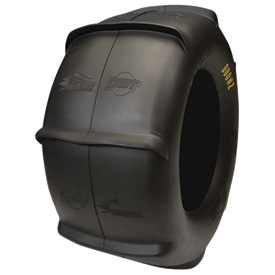
If you used a quadbike with 4 wheel drive, bigger tires, a mud-tire tred, some safety floatation, it could work very well. The tire below works well for pushing water. The bike would have to be designed to withstand saltwater, which is probably the real hard part of this idea. But it could be done and would be fantastic to drive around the ocean at high speed. So commuting from your floating home to someplace on land could be very fast and a lot of fun. If you are not needing to go far, a 4 wheel drive electric might be easier to make resistant to salt water. Also, if you have a solar powered floating home you would always be able to charge up an electric bike.
Another video with several guys doing it many times:
Wednesday, February 11, 2015
Development Plan
Why I want to develop the Quadmaran design
- It has very stable motion while still being able to move reasonably well.
- It can chain together making a train of boats. This allows a real community while still on the ocean. Can visit a friend, a group can work on a project, group can cross an ocean together, etc.
- For the size it is light weight. The cost of a boat grows with the weight so a very stable boat with enough room that is still light weight is very nice.
- Plenty of room for solar panels.
Development Plan
All versions will be able to operate alone or chain together with others of the same type making a train of boats. We plan to build at least two of each type. Each new type will be about twice the length of the previous type.- Quadmaran-5 Robot boat for developing software.
- Quadmaran-10 Carry batteries for night operation. Tow a kayak.
- Quadmaran-20 Big enough to carry 500+ lbs each, so we can ride.
- Quadmaran-40 Big enough for trips to other islands or ferry type service.
- Quadmaran-80 Big enough for a family to live on very comfortably.
Quadmaran-5
This 4+ foot long model is big enough to hold a solar panel, batteries, cell phone, and motors. So we are working out the hardware and software to do this. See www.islandboys.ai for current progress on this project.
Crowdfunding idea for this one is to offer people a copy of our software if they donate something or to open source it if we get over some amount. This way other people could make solar robot boats. Could also put logos on the boat.
We have one almost built but would like to build a second which will cost about $1,000.
Quadmaran-10
This will be able to carry about 70 lbs worth of batteries, solar, motors, etc. It will be strong enough to pull a kayak, so testing will be fun for me and my boys. Will try to crowdfund this and offer people use kayak and this as a tow boat for some period based on donation amount.
This will be made from foam like the Quadmaran-5 was but we put batteries and motors inside each of the 4 floats. It will have enough battery capacity to operate through the night. Should be able to go long distances like across the Caribbean or even the Atlantic. It will be covered with many coats of Styrospray and at least one of fiberglass or some other screen/cloth material. This will make it much tougher than the Quadmaran-5. It will be strong like a kayak or small fiberglass boat.
Cost estimated at $2,500 each. We want 2 for total of $5,000.
Quadmaran-20
The Quadmaran-20 will be 20 feet long and 10 feet wide. It will be able to hold 500+ lbs. With 2 of these connected together my family could motor around.
It will use aluminum trusses for the framing. Batteries and motors will be inside each of the 4 floats. The floats will be foam poured in a mold and covered with styrospray and fiberglass or material as the floats in the Quadmaran-10.
Crowdfunding people will get use the whole thing for some period of time for some size donation. Maybe 1 hour, 3 hour, day, and week amounts.
Cost estimated at $15,000 each. We want 2 for total of $30,000.
Quadmaran-40
The Quadmaran-40 will be 40 feet long and 20 feet wide. It is using an aluminum pipe as the main body and off-the-shelf aluminum trusses for much of the rest. Both of these can all bolt together quickly. The floats will be made by pouring foam into a mold and then covering with styrospray and/or fiberglass.
Quadmaran-80
This will be big enough for a family to comfortably live on. Chained together several families can form a community for as long as they want to. This might be to cross an ocean or work on some project, or just to get together for dinner. If you had a large number connected together the walkway on top lets you go to the one you want to visit without disturbing others along the way.
To see more images check this site out.
Monday, January 26, 2015
Android Robot Boat Project
My boys and I are making our Quadmaran model into a Robot Boat using an Android phone. This is now a home school project. As part of this the boys will be writing their own blog posts to get more writing practice. They are also writing the code for the phone using App Inventor which I am very happy with. This new blog is at http://www.islandboys.ai/. The boys first post shows what parts we have ordered.
Saturday, November 29, 2014
Aluminum Pipe Quadmaran
I am thinking of a prototype floating house that could be large and still not too expensive. You can buy huge corregated aluminum pipes for about 1.66 times the cost of aluminum.
They come in sections that quickly bolt together. So it is easy to ship and only takes a few days to put together. It comes up to 1/4 inch thick, so it can be very strong. It is called structural aluminum plate.
There are also aluminum beams that you can put around the circumference and also along the inside along the length of it. So you can make it very strong and also strong in particular parts.
My idea is to use make a quadmaran out of this by attaching 4 floats and then covering the top with solar panels. A picture of a model is below.
The floats could be attached with 4 aluminum truss sections between each float and the main body. Two spaced well apart up high and two spaced apart down low. All 4 coming next to each other above the float and a 90 degree turn to 4 more trusses that go down into the float. The ends may have to be cut and welded but it would not be too much welding.
The float would have the aluminum trusses for strength and then foam and a covering of styrospray and/or fiberglass.
This could be very cheap and very fast to build. You could end up with a living space much larger than any boat in this price range. Solar and electric would make it cheap to operate. The quadmaran design makes it very comfortable and stable, even when going slow.
The connection points to make a train of these would have to be strong enough too. One idea is to have a big beam running along the floor and sticking out at both ends. Another is to have some beams come to a point in front and behind, like a nose and tail on the pipe. Engineering details need to be worked out but I don't think it will be a problem.
In a normal house you spend roughly as much on the land as on the house. Here you would have this as the equivalent of the land cost and then the house would be built in/on this. But the end result could be comparable to a significant slice of houses in the USA. There will be plenty of people who could sell their house and buy one of these. There should be a good market.
I am going to double check the structural engineering and if this still looks good then I think I will try crowd funding with indiegogo or kickstarter. If you donate $100 you get to ride on it for a day. If you donate $1000 you get the whole thing for a day. But if anyone wants to start donating early, I happily accept paypal, bitcoin, credit card, Western Union, cash, check, gold, silver, or wire transfer.
Quadmaran Train With 3 Models
I tested 3 models in train formation with a better joint between them. The first with 3 floats rolls much more so I like the quadmaran design better.
The joint is very simple. On the back of one model is a piece of wood with a screw head sticking out. This can be thought of as a trailer hitch except that it is aimed back instead of up. The front of the other boat has a piece of wood with a small hole drilled in big enough for the screw head to fit into. Then rubber bands are connected from the posts on the sides of the models to pull them together (keeping the hitch connected) and also keeping the models lined up straight, but with plenty of flexibility.
The little sandbags are to simulate the weight of the lead batteries that would be above each float in a full sized solar powered version.
On each side there are 2 rubber bands chained together. They are stretched to about 18 inches. At rest they are 8 inches. I measured 0.64 lbs pull when stretching one to 18 inches. I also measured 1.12 lbs pull at 28 inches. Close to Hooke's law. This model is 1:16 scale, so full sized would be 16 times in each of 3 directions, or 4,096 times the displacement or mass. So if the rubber bands here are 0.64 lbs pull, in full scale it would be 0.64*4096=2,621 lbs. This is small enough that it could be done with a hand winch and a stretchy rope.
I would like to point out that all natural waves are used in my wave tank. This keeps costs down. Pretty sure my wave tank has the best view of any wave tank used for testing experimental boat models. :-)
Blow is a video. Be sure to notice how the boat in the upper right is tipping as much or more than my tiny lightweight models are. If these models were scaled up 16 times in each direction, so 4096 times heavier, they would hardly move in these waves.
And the next is really very similar so only the most dedicated need watch both:
And a shot of two of my boys:
Subscribe to:
Posts (Atom)